The Huberman Lab: translational research in action

If you’re a podcast listener and generally into health and fitness, I’d be surprised if you haven’t heard of the Huberman Lab. Originating from Stanford University, under the direction of neuroscientist Dr. Andrew Huberman, the Huberman Lab released a podcast in 2021 which has become on the of the most listened-to shows in the world. In fact, it’s been consistently ranked #1 in the categories of Science, Education and Health & Fitness and currently boasts 2.8 million subscribers.

According to Dr. Huberman, the mission of the podcast is to provide “zero-cost information about science and science-related tools” with the goal of explaining how the brain controls our perceptions, behaviours and health, as well as measuring and impacting the nervous system. The research and tools presented cover many areas of interest, including enhancing sleep quality, improving physical fitness and cognitive ability, maintaining motivation and reducing levels of anxiety. You can check out an example of one of the podcast episodes here:

In many cases, Huberman interviews other scientific experts in the area he wishes to discuss. Past interviews have included Dr. Alicia Crum, a tenured Professor of Psychology at Standford (see video above) and Dr. Wendy Suzuki, a Professor of Neuroscience and Psychology at NYU. In a world where so much of our information comes from unreliable sources, it is encouraging to know that experts like these are reaching almost 3 million subscribers! To me, it’s an excellent example of translational research in action. Huberman is providing the public with science-backed tools that are accessible, easy to implement and can have a direct positive impact on their lives.

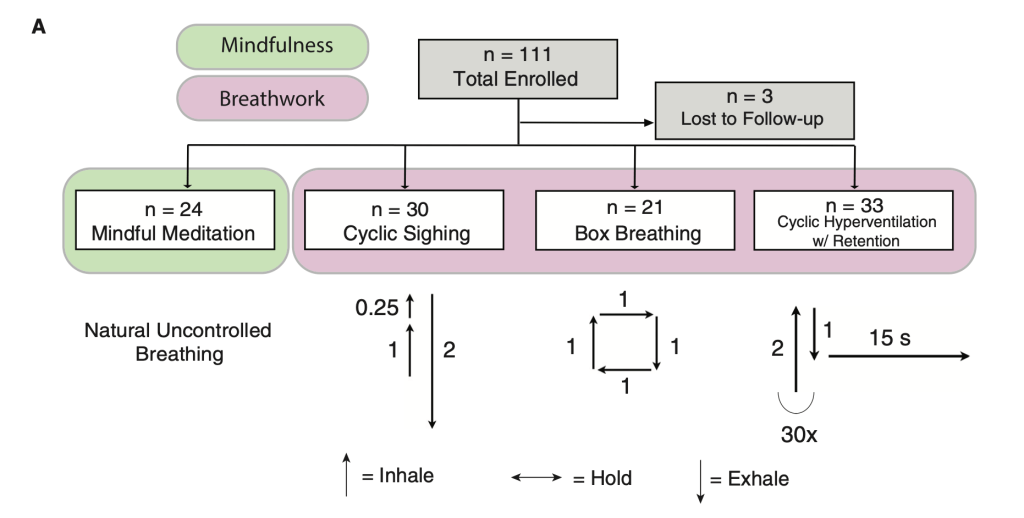
I can personally attest to one of Dr. Huberman’s recommendations, which is backed by a study he and Dr. David Spiegal published in the open-access journal, Cell Reports Medicine, entitled Brief structured respiration practices enhance mood and reduce physiological arousal. The study is a remote, randomised, controlled study looking at breathwork practices as potential tools for stress management and well-being. In the study, three different daily 5-min breathwork exercises are compared with a 5-min mindfulness meditation practice over one month. The breathwork exercises include cyclic sighing (i.e. prolonged exhalations), box breathing (i.e. equal duration of inhalations, breath retentions and exhalations) and cyclic hyperventilation with retention (i.e. longer inhalations and shorter exhalations). Both improvement in mood as well as reduced physiological arousal (i.e. respiratory rate, heart rate and heart rate variability) were used to gauge the results of either technique, through tools such as the WHOOP tracker and two online questionnaires – the State Anxiety Inventory and the Positive and Negative Affect Schedule – delivered to participants before and after completing their daily exercises. You can see the experimental set-up and the sample sizes in the figure below:
Whilst both the mindfulness meditation and the breathwork groups showed significant reductions in ‘state’ anxiety (i.e. transitory emotional state consisting of apprehension, nervousness, an increase heart rate, etc.), breathwork and specifically cyclic sighing was the most effective tool for increasing overall positive affects, as can be seen in the figure below:

Indeed, breathwork specifically produced a significantly greater reduction overall in respiratory rate and a higher daily increase in positive affects over the course of the study. Since hearing about these results, I’ve started combining deliberate breathing exercises alongside my daily meditation practice over the last few weeks or so and can certainly say it’s had a positive overall impact on my life! You can see more of the Huberman Lab’s publications here.

It’s important to note that the Huberman Podcast certainly wasn’t the first and nor is it the only example out there of everyday simple, fast-acting and cost-effective translational research in action. You can find several other examples of scientists or doctors taking their research from the lab to the public below, including Professor Matt Walker ‘s Sleep Podcast and cardiologist Dr. Sanjay Gupta’s YouTube channel, York Cardiology.

An Intro to Deep Tech

Likely when you think of the words ‘deep tech’ – you picture futuristic technologies being built by scientists in labs. And you’d be mostly right! Deep technology is defined by most as technologies based on ‘tangible engineering innovations or scientific discoveries’. Except that deep tech isn’t really meant to be ‘science for the sake of science’, like a lot of the fundamental (but also amazing) research that you find in labs. Instead, deep tech is meant to be focused on practical, STEM-driven solutions to some of the biggest issues we are facing as a society. I mentioned some of the applications of deep tech recently in another post – but these can include tackling cancer treatment and diagnosis, facing up to climate change, feeding the world’s population and yes, even managing a global pandemic.

So what is included under the deep tech umbrella? According to the Boston Consulting Group, who’ve written a great deal about the field, here are some key areas of focus:

  1. Biotechnology
  2. Nanotechnology
  3. Drones
  4. Robotics
  5. Advanced materials
  6. Blockchain
  7. Quantum computing
  8. Artificial Intelligence
  9. Photonics and electronics
An example of some ‘deep tech’ I created myself! Gold nano stars aimed at boosting the fluorescence of dyes used in tumour resections.

I’m sure most people have heard of at least a few of these buzzwords before! Looking a bit further, the common pattern that emerges from glancing over this list is that many of these different technologies are new, cutting edge and often protected by patents. They are built and driven by those with deep scientific or engineering backgrounds and they are likely to emerge from large, well-established institutions like research centres, hospitals or universities. As was touched on above, they are also mostly problem-oriented (i.e. aiming to solve society’s greatest challenges). And since investment is always a focus here, you can certainly appreciate that it takes a great deal of it to get some of these technologies off the ground! In other words, they can be tremendously capital intensive and require millions of dollars before they’re brought to the market.

Another interesting fact – unlike most software-focused ventures, as much as 83% of deep tech innovations are built around a physical product. So this begs the question – are Facebook, Google, Uber or Amazon deep tech? Well in this day and age – not really. These Internet app-based megastars are actually just mainstream (ok fine – boring) tech. The line is – of course- a bit blurry – but they aren’t exactly built on a new scientific discovery which has taken years and lots of capital to develop. But that doesn’t mean they don’t include (or intend to include) deep tech. In fact, back in 2018, Facebook opened a new lab in London to support start-ups solely focused on deep technology. This kind of move made sense for a tech company focused on investing in artificial intelligence, deep learning and even augmented and virtual reality – all deep tech. Indeed, deep tech itself has actually long been identified as a category for investment, as a sort of subsection of the tech industry. And investment into deep tech has been increasing. In fact, according to a report released by the Boston Consulting Group, disclosed investment into deep tech has grown to more than $60 billion in 2020 (it was apparently $15 billion in 2016). The report mentions a few other figures which paint a picture of the deep tech investment landscape over the same time period:

  1. Private investor transactions into deep tech have rose from $13 million to $44 million
  2. Investments from corporations into deep tech have rose from $5 billion to $18 billion

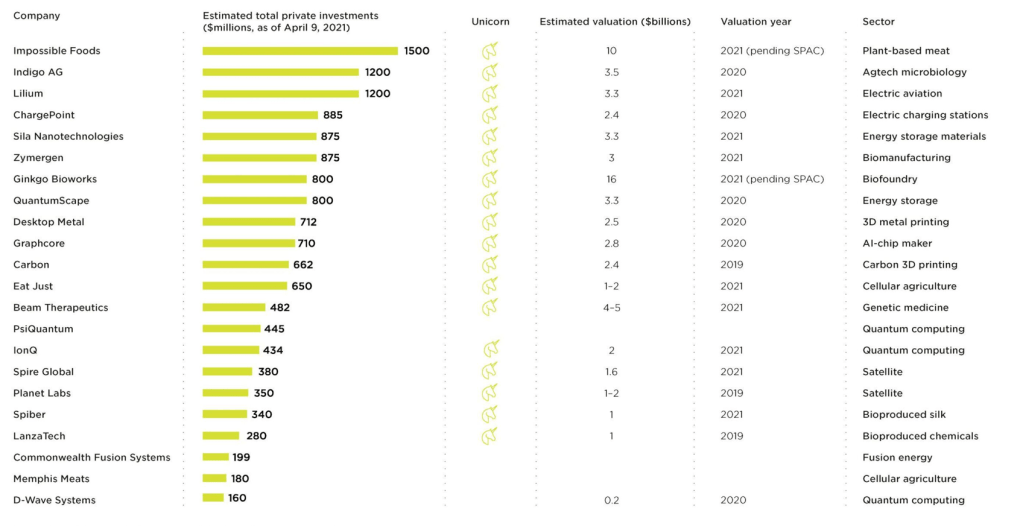
Now, increased investment into a certain field isn’t really anything to brag about. In fact – from the point of view of the investor – it can be quite a bit better to go where no one else is going, since it means that the company isn’t overhyped and therefore possibly overpriced. Plenty of deep tech initiatives are unfortunately very likely to be both of these things! But what this increased investment does indicate is an increased ‘trust’ from investors in newer and risker areas such as the ones mentioned above. And that’s good news for a field that requires so much capital to get going. I mean, just look at the estimated total private investments listed in the chart below, for some of deep tech’s ‘success stories’:

Taken from BCG’s Meeting the Challenges of Deep Tech Investing, this chart shows selected examples of deep tech success stories. That unicorn symbol means that the company is privately held and valued over $1 billion. And take a look at some of those sectors – lots of quantum computing in the list!

Alongside the high capital requirements needed at the beginning of a deep tech venture, investors also have to be comfortable with the fact that it can take years before the technology is ready to hit the market and start generating returns. In fact, 7-10 years is quite a common timeframe for investors to face before they start reaping the rewards of their investment. This fact alone would make many investors queasy! So who on earth are these (supposedly very patient) investors and what drives them? This remains a key interest of mine and I’ve actually conducted interviews both with deep tech investors and with deep tech start-ups on the process of seeking and receiving investment. I can cover my findings from my interviews in another post in detail. I am also really interested in researching the entire deep tech commercialization pathway from lab to market – so I can create another dedicated post on that as well! But for now, key investment into deep tech tends to come from:

  1. Angel Investors – high-net-worth individuals who provide financial backing for early-stage start-ups
  2. Venture Capital (VC) – a form of private equity financing provided by a firm to early-stage, and emerging companies with high growth potential
  3. Public Funding – through government, academic or research grants

Deep tech-focused angel investors tend to be highly-experienced business leaders and very passionate about their field(s) of choice. They may have backgrounds in science and/or engineering and perhaps have become recently retired and now have money to spend. Key fact here – this money is their own. More often than not, they want to become deeply involved in the company they’re investing in – either as mentors to the founding team or as partners in the business. Although returns are important to them, many angels understand that start-up investment is a complete gamble – they are investing more to seek fulfillment and to help accelerate a field/team/technology/cause that they believe in.

On the other hand, VCs tend to be more returns-focused. Because they are investing money on behalf of an external investor (i.e. a university, high net-worth family or even a corporation) as a firm, they are more often obligated to find and invest in businesses with a demonstrated growth potential. Growth tends to be a key word in VC. Trouble is, the kind of growth that most VCs seek just doesn’t apply to early stage deep tech. For example – not many new immunotherapy-focused companies are measuring their customer churn rates! They’re just trying to get the technology developed and out there in the first place. Luckily, there’s a growing number of deep tech focused VC firms which are able to provide more targeted help. Here are a few:

Ahren Innovation Capital
LongWall Ventures
Earlybird Venture Capital
Deep Tech Ventures
Angular Ventures
Propagator VC

As deep tech-focused VCs, these guys can be expected to be more familiar with advanced science (at least you’d hope!) and should accordingly expect to carry greater fund sizes with longer lifetimes and have access to the appropriate experts to vet deals.

Finally, despite increased private backing from angels and VCs, public or grant funding of deep tech is still very common and is likely the first type of funding that a scientist-turned-entrepreneur might reach out for when they begin the commercialization process. This is particularly true of PhD students who are looking to turn their research into a company. Due to their time spent in academia, they are likely to be most familiar with the grant schemes so often associated with their universities. Alongside angels, VC’s and public funding, other types of investment into deep tech might include donations-based funding or even crowdfunding. Propel(x) jumps to mind as a deep-tech focused crowdfunding platform targeted towards angel investors (with a female founder).

Hopefully this article has helped to provide a bit of insight into the world of deep tech and provided some context for future blog posts! If you want to read more about it, deep tech is often included in the Science, Tech or Health sections of many news sources.

The Case for the Split PhD

From vaccines to solar cells, the kind of tech we need to solve some of the world’s biggest problems tends to be generated in labs by scientific researchers with ‘Doctor’ in front of their names. However, in the UK, only 0.5% of STEM PhD students choose to license or spin-out their research every year into usable products or services [1]. Whilst this figure may seem unnaturally low, it is actually a relatively unsurprising statistic, given that the inherent aim of the PhD is to uncover novelty, as opposed to create a scalable venture. Indeed, according to my conversations with researchers and experience in early-stage science, in most places, building a venture out of PhD research is at best an afterthought and at worst, a major inconvenience and distraction.

It all tracks back to the early incentives that these projects are built on. Typically, those incentives tend to be focused on publishing research in high-impact scientific journals – a feat which is often so highly-rewarded in academia. Indeed, it is hardly a secret that frequent publication of research tends to demonstrate academic talent and brings positive attention to scholars and their institutions, particularly in terms of grant funding. To achieve this kind of research often means uncovering scientific novelty – critical to expanding our knowledge of any one field – as opposed to uncovering simple and straightforward ‘value’, so to speak. The ‘publish or perish’ cycle is summarised nicely in the figure below:

Since incentives tend to drive outcomes, it makes sense that most PhD students are encouraged to focus on achieving exciting, publishable results, as opposed to the wider scalable value of their research. The situation is further complicated by the fact that the PhD has historically been built to train (and recruit) our future tenured academics. Think about it – you’re conducting lab research (often individually), analysing data, writing up your findings in a 300-page dissertation, completing government grant proprosals, presenting the core science of your work at academic conferences and learning how to juggle the academic ladder. And whilst there’s certainly elements of a PhD that lend themselves well to entrepreneurship (i.e. plenty of independence, the need to pivot and ‘pitch’ for funding), it’s hard to argue against the clear pathway into a postdoc, PI and beyond. Indeed, according to a 2020 study by the Higher Education Policy Institute, PhD students feel well-trained in analytical-thinking, data and technical skills, along with presenting to specialist audiences and writing for peer-reviewed journals [2]. However, they are far less confident in managing people, applying for funding and managing budgets – all key parts of launching a venture.

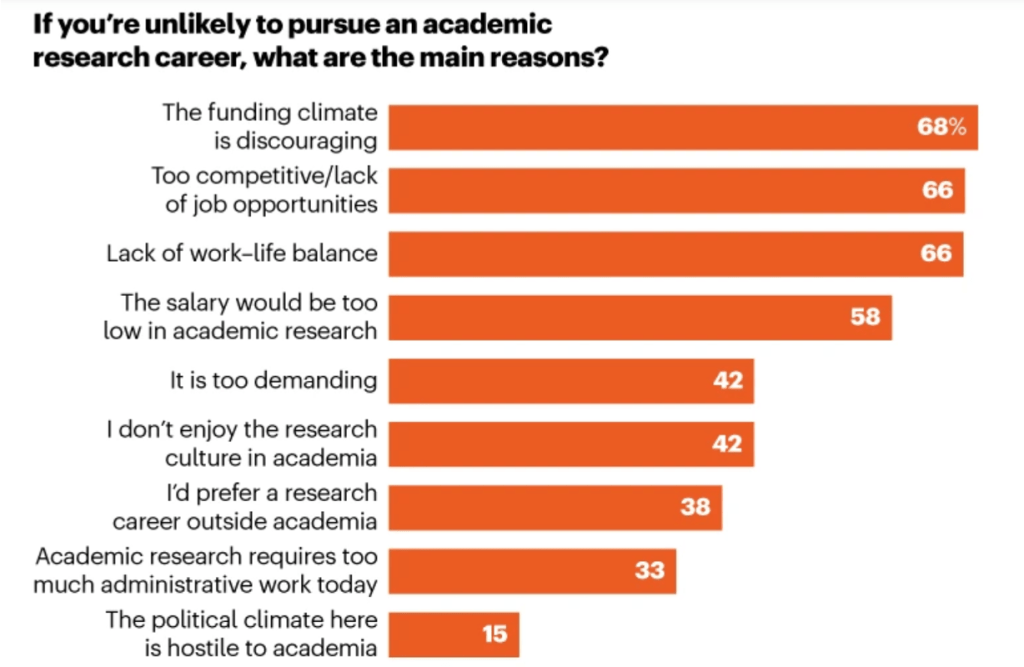
Now what’s also interesting, is that while 67% of PhD students want to become tenured academics, only 30% actually remain in academia three years on, despite being rigorously trained to become academics [2]. Some of the reasons why graduate students are unlikely to pursue an academic research career are summarised in the plot below, taken from a 2022 Nature article entitled‘I don’t want this kind of life; graduate students question career options’ [3].

To me, this seems like a lost opportunity to seize the significant value to our society that these highly-trained students and their research can offer. I therefore think it’s worth pursuing a so-called ‘split’ PhD, in line with what editor Julie Gould suggested in her 2015 Nature piece entitled ‘How to build a better PhD’. According to Gould, there are currently too many PhD graduates for academia [4]. In other words, there is a mismatch between the number of PhD graduates and the number of available secure academic positions for those graduates, which explains why so many are forced to leave. As such, we should consider splitting the PhD in two – ‘one for future academics and a second to train those who would like in-depth science education for use in other careers’, says Gould. Whilst students in the academic-track PhD might focus on blue-skies research and discovery, the ‘vocational’ PhD would be more structure and directed towards areas such as machine-learning or radiography, for instance.

There are versions of this split which already exist, such as the EngD in the United States and Germany, which is a Doctorate in Engineering focusing on solving complex, industry-focused problems. There’s also the industrial PhD, in which private-sector companies will pay and employ students who are simultaneously enrolled in a university program to conduct research on their behalf.

Whilst these are two excellent options for more industrially-minded students, I am most excited by the new ‘flavour’ of PhD very recently introduced by London-based venture creator and investment firm, Deep Science Ventures. DSV’s new Venture Science Doctorate is reportedly diversity-first, venture-focused and directed towards two main themes – either building global climate resilience or advancing healthcare through venture creation [5]. Over a three year program, the candidates will take on a project ranked by impact and feasibility, enter the lab, begin research and prototyping and finally, incorporate a company and raise seed investment. On top of creating a new company, the students will also publish a (supposedly modified) thesis, policy whitepaper and investment memo. They posted a webinar on it which you can find here and you can see the program outline below:

What I love (so much!) about this program is it’s direct focus on shifting incentives early on from creating something novel to be published towards creating something of value to be commercialised, for the benefit of those venture-minded scientists (and our society as a whole). Current supporters include Thomas Kalil, the former Deputy Director for Technology and Innovation at the White House and Priya Guha, MBE, a Venture Partner at Merian Ventures and Board member at UKRI. By 2026, DSV aims to have trained their first 10 PhD candidates, who will have incorporated a company each in the healthcare or climate space. You can read more about it here

Of course, it’s important to note that programs like the Venture Science Doctorate should not be meant to replace the PhD. Instead, the goal would be to put forward an alternative to the current programs on offer. The fundamental research done by traditional PhDs is also imperative – but my focus here (and passion) is on translational research!

It would be great to hear thoughts from others in the field around the idea of splitting the PhD and the different flavours it could take.

References:

[1] Are British universities holding back tech spin-outs with unreasonable equity demands?

[2] New report shows 67% of PhD students want a career in academic research but only 30% stay in academia three years on

[3] Woolston C. ‘I don’t want this kind of life’: graduate students question career options. Nature. 2022 Nov; 611(7935):413-416. doi: 10.1038/d41586-022-03586-8. PMID: 36344617.

[4] Gould J. How to build a better PhD. Nature. 2015 Dec 3;528(7580):22-5. doi: 10.1038/528022a. PMID: 26632571.

[5] Why we need to reinvent the PhD, Deep Science Ventures

The Translational Research (TR) Index

From my experience as a Masters student in med tech, it can be difficult to understand the wider impact of your research and its potential for being translated into a usable tool for clinicians. This can be frustrating, particularly if you, like me, are more drawn to the potential applications of your work, as opposed to simply its scientific novelty.

With this in mind, I’ve decided to have a go at creating a ‘Translational Research’ – or TR – Index. The idea is very simple – score a potential research project based on a handful of key criteria which serve as indicators of translational potential. In doing so, we could achieve a couple of important insights:

  1. Understand the kind of research project being proposed
  2. Direct funding to appropriate places
  3. Direct resources (i.e. staff, equipment, etc.) to appropriate places
  4. Establish incentives early on and influence outcomes 
  5. Influence recruitment 
  6. Establish appropriate relationships, joint ventures, partnerships etc. based on incentives and outcomes

Much like an investor screening through stocks which meet a pre-defined set of variables, we could theoretically score projects using the TR index and then screen through projects which satisfy the specific translational criteria we are hoping to meet. This not only gives us an idea of how high the translational potential of a project might be but also allows us to possibly screen various projects based on specific goals (i.e. knowledge expansion, commercialisation, IP generation, etc.).

The TR Index could be defined by the following scoring system, resulting in a ‘Translational Value Potential (TVP):

  1. Hypothesis (45 points)
    • Hypothesis tested by fast, frugal experimentation based on simplicity, feasibility and clinic/market relevancy (45)
    • Hypothesis tested by experimentation based on clinic/market relevancy (23)
    • Hypothesis tested by any experimental parameters necessary to further knowledge, without regard to clinic/market application (0)
  2. Involvement of end-user (25 points)
    • End-user directly involved in project design and testing (25)
    • End-user indirectly involved via a partnership, joint venture, etc. (12)
    • End-user has no involvement in the project design (0)
  3. Timeframe (5 points)
    • Measurable timeframe to achieve specific, ‘usable’ deliverable (5)
    • No time timeframe to achieve specific, ‘usable’ deliverable (0)
  4. Scalability (20 points)
    • Synthesis process can currently be implemented at scale (20)
    • With reasonable development, synthesis process can eventually implemented at scale (10)
    • By definition, synthesis process unable to be scaled (0)
  5. Intellectual Property (5 points)
    • Project generates entirely new IP (5)
    • Project builds on prior IP (0)

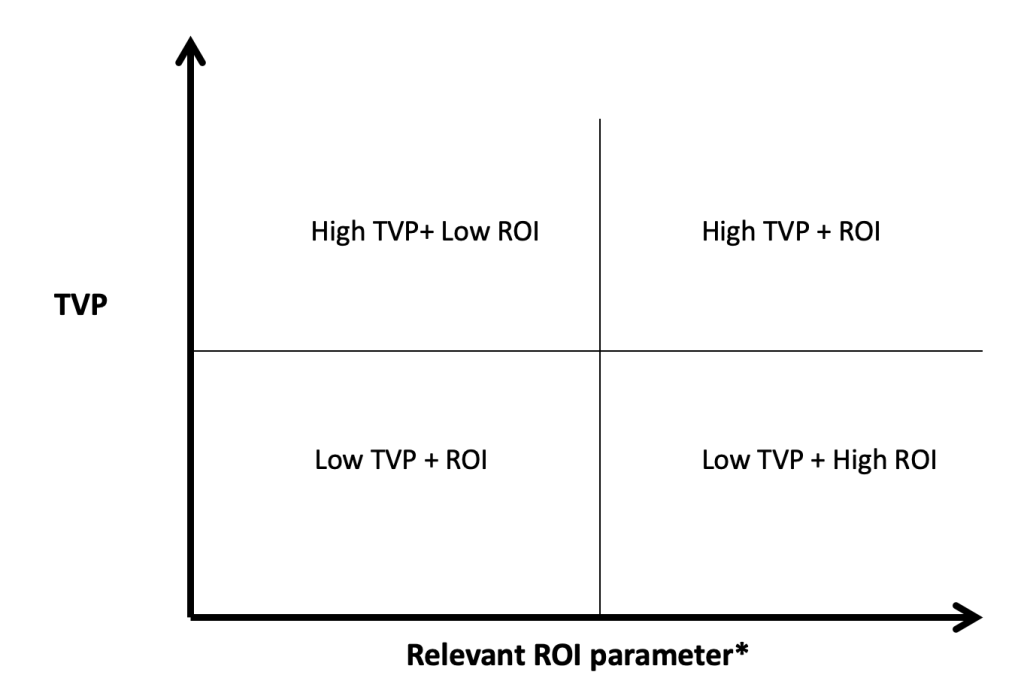
The TVP would then be summed out of 100 and reported as a percentage. We could then actually add the TVP to a relevant ROI parameter, to give further insight into the actual economic (or even social) returns on the project.

Some possible ROI parameters might include:

  1. Estimated economic ROI
  2. Estimated external investment into the project as % of project costs
  3. Estimated income from/value of consultancy contracts as a % of project costs
  4. Estimated income from/value of licenses generated as a % of project costs
  5. Estimated revenue/market value of active spin-outs or start-ups created as a % of project costs

The ROI parameter might change with the goals of the project or the field it’s in. For example, a project focused on delivering value to patients might focus on objective evidence of health improvements in outputs such as reduced deaths, hospital admissions or attendances at health clinics.

I will use another post to demonstrate the application of the TR index to an existing research project, but for now, I thought it might be useful to list the (many) improvements needed to make this index into a practical tool, as it is still a work in progress after all!

  1. Clearly, the index will be far more useful if it is modified to apply to different fields – translational potential in the semiconductor industry is defined very different to how it might be in med tech, etc.. I will look at making indexes specific to different fields if there is demand for something like this.
  2. It can be challenging to bridge the gap between novelty for the sake of furthering knowledge and creating something ‘useful’ that can be applied – both are important. We need to ensure we aren’t ‘discouraging’ the development of complex, novel innovations which might take longer to produce but still might provide us with great value (whether academic or translational). As such, the index should merely serve as an indicator of early project incentives and potential outcomes as opposed to a tool for ‘ruling out’ any projects with too long a timeframe or too complicated an agent. How can the index be improved to ensure we don’t ‘discourage’ against the more complex scientific innovations?
  3. I have included involvement by the end-user as part of the criteria. To me, it is critical that the end-user play at least some role in the development of a project which is meant to deliver them with a new innovation. Like a start-up founder thoroughly understanding market trends before pursuing a business idea, I believe a research team focused on creating a usable innovation should think very carefully about who the ‘consumer’ of that innovation will be. At the same time, I understand that these projects can be inherently complex and perhaps at a stage where it might be difficult or next to impossible to even consider the end-user. Perhaps it would be worth thinking about how we might modify the index for these kinds of projects.
  4. The words ‘frugal’, ‘fast’ and ‘feasible’ and ‘simple’ need to be further defined and perhaps even weighted to introduce further scoring into the Hypothesis criteria. Again, the way these metrics are defined is very likely to change by the field we are considering.

Next steps regarding the index will include plenty more research as to how R+D projects are currently planned and evaluated within academia and industry. Some useful resources I’ve found include:

  1. Rates of Return to Investment in Science and Innovation (2014), by Frontier Economics
  2. Metrics for the Evaluation of Knowledge Transfer Activities at Universities (2007?), by Library House
  3. A Multi-Criteria Decision Support System for R&D Project Selection (1991), written by Theodor Stewart at the University of Cape Town

I also hope to eventually get feedback from someone at a Research Council or university and use it to further refine the index based on their needs. Finally, I’m going to try and address some of the points I mentioned above to try to further improve the index.